Prior to the 2024-2025 academic year, NCAA Division III adopted NPI as its new ranking system for all team sports, thus automating the process by which teams are selected and seeded for national tournaments. While the system is the same across sports, individual sport committees had the ability to evaluate and tweak the underlying parameters within NPI to balance and reward things like winning percentage, strength of schedule and quality wins as they deemed appropriate for their sport.
Most sport committees settled on a 25/75 or 20/80 split between winning percentage and strength of schedule, with the men’s soccer committee breaking slightly more in favor of SOS at 15/85. Football was an extreme outlier in the other direction at 40/60.
[RELATED: What D3 Football Fans Should Know About NPI]
As we did a year ago, we wanted to take a look at how the 2025 Division III football playoff would have been shaped if the football committee had chosen a winning percentage/strength of schedule weighting more in line with their peer sport committees. To do so we took all the actual game results from the 2025 football season and re-ran NPI using the following four splits between winning percentage and strength of schedule:
30/70 – No sport committee chose this weighting but we took this as our first case for comparison because it allows football to continue to be an outlier toward winning percentage but less severely than the actual 40/60 split.
25/75 – This was the most common WP/SOS dial setting, chosen by men’s basketball, men’s and women’s ice hockey, men’s and women’s lacrosse, baseball and softball.
20/80 – The second-most popular WP/SOS dial setting, chosen by women’s soccer, field hockey, men’s and women’s volleyball and women’s basketball.
15/85 – This was the most extreme weighting toward strength of schedule, chosen only by the men’s soccer committee.
Here are those results side-by-side with the actual results with the 40/60 WP/SOS split.
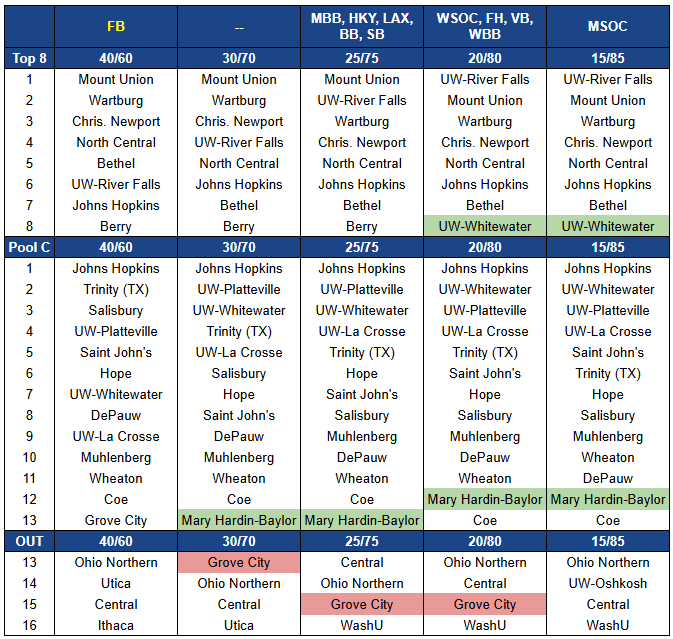
A couple things immediately stand out in the results above, starting with just how few changes there would have been to the at-large selections and Top 8 seeds. That’s a change from this analysis run for last year’s playoffs where there were multiple changes to the at-large selections and a change in the Top 8 right away.
That’s likely in part because of the WIAC’s ability to use a tremendous non-conference showing to brute force their way through the bias toward winning percentage in a way they were perhaps just a step short of a year ago. Certainly the results above show a strengthening in the seeding for the WIAC schools, including a second Top 8 spot, as the dials give strength of schedule more importance, but they already got four teams in as it is. In fact, with the WP/SOS weighting chosen by the men’s soccer committee, the four WIAC playoff qualifiers would have all been among the top 10 overall seeds.
Mary Hardin-Baylor’s at-large chances were a topic of much discussion through the season. Here they show up as the one change that would have been made to the at-large teams, at the expense of Grove City, had the dials leaned into strength of schedule more.
Interestingly, Ohio Northern’s position was really not impacted by the WP/SOS dial settings at all as they show up as the first or second team out regardless of how winning percentage and strength of schedule were weighed. We saw this same dynamic a year ago with Wheaton. The Thunder were the first team out when the 2024 playoff field was set (albeit with one fewer at-large bid available than the 2025 playoff) and bounced around between first and third as we changed those dials.
The NPI dials for football being set so heavily in favor of winning percentage has been controversial but it is likely that a 2025 playoff picture set by dials skewing more toward strength of schedule would have been even more controversial with the inclusion of Mary Hardin Baylor and the WIAC’s strengthened seeding.
NPI isn’t without it’s quirks or issues, especially for football, but maybe the dials are actually ok. At the very least, it’s a good example of why the NCAA Division III Championships Committee is requiring multiple years before any dial changes can be recommended. No one wants a moving target or to make changes on a perceived issue that may only be a one-year issue or actually no issue at all.
D3Datacast.com is presented ad-free for all thanks to the generosity of our supporters. For more information and to join the team, see our page on Patreon.
 D3 Datacast
Leave a comment