Division III sports have entered the NPI era with national tournament fields being selected and seeded by the NCAA Power Index rather than by human committees. To say the process has no human involvement is not quite right as NPI requires decisions to be made about what and how certain things will be rewarded. From there, however, it’s a “set it and forget it” system. With 12 at-large bids available to fill the new 40-team bracket, the 12-highest NPI scores that did not win their conference’s automatic bid are added to the field with no further discussion or decision-making.
Once NPI was formally put into place by the Championships Committee they tasked the individual sport committees with proposing their “dial settings” for how to reward things like winning percentage, strength of schedule, quality wins and more. Most sport committees settled on a 25/75 or 20/80 split between winning percentage and strength of schedule, with the men’s soccer committee breaking slightly more in favor of SOS at 15/85. Football was an extreme outlier in the other direction at 40/60.
[RELATED: What D3 Football Fans Should Know About NPI]
Now that we have the first-ever Division III Football Playoff field selected by NPI it begs asking the question: what if the football dials were more in line with other sports?
Thanks to NPI’s objective nature and our ability to replicate results for ourselves, this is a question we can answer. It’s just a matter of running results like we have been doing to track NPI since week one, but by changing out the WP/SOS split to see what results it produces at other dial settings. All other dial settings and decisions the football committee could have made will be left alone. A number of variables are at play for anyone trying to find an optimal set of dials but that’s a different task for a different day. We will just hone in scenarios isolating differences in how winning percentage and strength of schedule could be valued, leaving everything else as is.
Under the actual dial settings with a 40/60 split between winning percentage and strength of schedule, Saint John’s, Hardin-Simmons, Salisbury, Cortland, North Central, Mount Union, DePauw and Lake Forest earned the top eight seeds. The top eight is of extra importance with bracketing principles in place to treat these as “protected seeds” and keeps them separated from each other regardless of what the usual geographic constraints may say about bracketing.
Pool C (at-large) selections to the 2024 playoff were Carnegie Mellon, Grove City, Ursinus, Whitworth, Texas Lutheran, Bethel, Coe, Centre, UW-La Crosse, Trinity (TX), Mary Hardin-Baylor and John Carroll.
Wheaton, UW-River Falls, Wabash and Alma were left as the first four out.
That’s what we got, but what could we have gotten? We chose four other WP/SOS weights to run through NPI to see what kind of results they produce. They are as follows:
30/70 – No sport committee chose this weighting but we took this as our first case for comparison because it allows football to continue to be an outlier toward winning percentage but less severely than the actual 40/60 split.
25/75 – This was the most common WP/SOS dial setting, chosen by men’s basketball, men’s and women’s ice hockey, men’s and women’s lacrosse, baseball and softball.
20/80 – The second-most popular WP/SOS dial setting, chosen by women’s soccer, field hockey, men’s and women’s volleyball and women’s basketball.
15/85 – This was the most extreme weighting toward strength of schedule, chosen only by the men’s soccer committee.
[DON’T MISS: The D3 Datacast on YouTube]
Applying those various WP/SOS dial settings to the 2024 Division III football season produces these results for the top eight protected seeds, the 12 Pool C selections as well as the first four out to give a little more context regarding additional teams in the mix at the very end. Changes into the Top eight or Pool C picture from the actual have been highlighted in green, changes out of Pool C have been highlighted in red (provided they show up in the first four out)
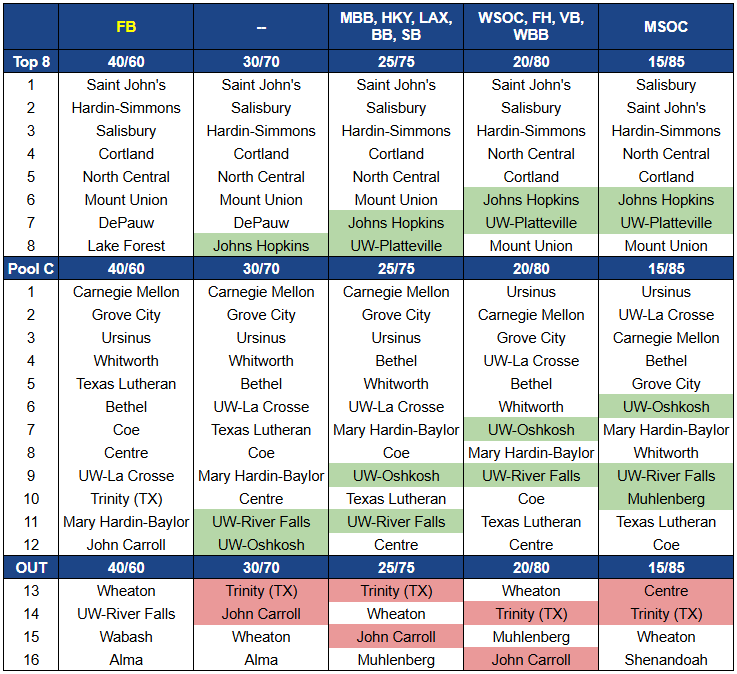
Schools from both the WIAC and Centennial jump out as losers in the current WP/SOS weighting as all four alternates see Johns Hopkins move into the top eight and UW-Oshkosh and UW-River Falls added to the playoff field. The gains for the Centennial are even bigger by going all the way to 15/85 as it would have vaulted Muhlenberg into Pool C position.
On the other end, Trinity (TX) and John Carroll show up as the big beneficiaries of the WP-heavy dial as both gained at-large bids but would have missed the playoffs had the dials been more in line with other Division III team sports. Also of interest, Wheaton shows up in the group of first four teams out in all five scenarios. While moving the dial changes a couple teams ahead and behind the Thunder, Wheaton remains stuck in “first four out” territory in all five cases.
Some changes to seeding within the top eight happen as the dials shift but a core group of six teams remains consistent: Saint John’s, Hardin-Simmons, Salisbury, Cortland, North Central and Mount Union.
Similarly, nine of the 12 at-large bids would have been selected in all five cases: Carnegie Mellon, Grove City, Ursinus, Whitworth, Texas Lutheran, Bethel, Coe, UW-La Crosse and Mary Hardin-Baylor.
The NCAA Division III Championships Committee opted for a one-size fits all approach with NPI despite the fact that football is different from other team sports due to fewer games played. This is especially true with limited, or in some cases non-existent, opportunities for non-conference games that are important for helping to link teams and conferences in the calculations.
This puts two questions into play.
1. Can NPI work for football?
2. If so, what are the best dial settings to make it happen?
Whether any of the outcomes presented above are preferable to what the actual current dial settings produced is a matter of personal opinion. However, it’s probably not going too far out on a limb to suggest most neutral observers may find a preference with one of the four comparison cases over the current actual case.
This draws into question just how well the football committee understood the assignment when they were tasked with using previous years of results to evaluate the range of dial settings before coming to a decision. A trial-and-error approach making a range of adjustments, not unlike what we have presented here, and coming to a decision on what it seems like can consistently produce a palatable set of results is what they should have done.
Regardless of whether the football committee is getting their intended results or immediately had regrets upon seeing the final numbers this season, these dial settings will be in place for at least another year. Only after two years can a sport committee discuss dial setting changes with the Championship Committee so that there aren’t overreactions to issues that may be one year anomalies and to avoid a moving target as programs create future schedules. Ideally that means committees did a good job of setting the dials initially. We will see what the future holds for football NPI.
D3 Datacast Links:
YouTube | Spotify | Twitter | Facebook | Patreon | Merch Shop
It is our commitment to the Division III basketball community to keep this site free of ads or paywalls. We are grateful for the teammates we have in that goal who have chosen to support us through Patreon.
 D3 Datacast
Leave a comment